Silver Investment Guide: What Really Drives Silver Prices
Half industrial metal, half precious metal. Why solar demand, investor flows and gold all move silver, and why it swings so much.
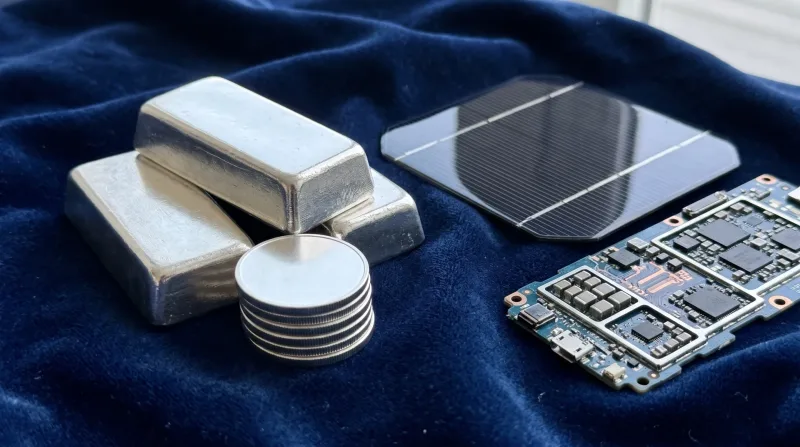
The short answer: Silver investment is driven by two kinds of demand: industrial use, especially in solar panels and electronics, which makes up around half of demand, and investor demand for coins, bars and ETFs. That mix makes silver far more volatile than gold. It can rise faster in booms and fall harder in slowdowns, so most investors keep it as a small part of a diversified portfolio.
Why silver is different from gold
Gold is mainly a store of value. Silver is both a precious metal and an industrial raw material. It conducts electricity and heat better than any other metal, which makes it essential in solar cells, circuit boards, batteries, medical equipment and car electronics.
Why it matters: silver prices respond to the economy and to factory demand, not just to fear and interest rates. That link explains its bigger price swings.
What drives silver prices
| Driver | How it affects silver |
|---|---|
| Industrial demand | Strong manufacturing and solar installations support prices |
| Solar "thrifting" | Manufacturers using less silver per cell can reduce demand |
| Investor flows | Coin, bar and ETF buying can push prices sharply |
| Gold price | Silver often follows gold's direction, with bigger moves |
| Interest rates and the dollar | Lower real rates and a weaker dollar tend to help |
| Mine supply | Most silver is a by-product of lead, zinc, copper and gold mines, so supply reacts slowly |
By the numbers: the Silver Institute reported that industrial demand slipped about 3% in 2025, mainly because solar makers used less silver, and it expects a further small fall in 2026, while still forecasting a market deficit for a sixth consecutive year and higher coin and bar demand.
The gold-silver ratio
The gold-silver ratio shows how many ounces of silver buy one ounce of gold. Some traders watch it to judge whether silver is cheap or expensive relative to gold. It has moved over a wide range in recent decades, so it is a rough guide rather than a reliable signal.
Ways to make a silver investment
| Option | Pros | Cons |
|---|---|---|
| Coins and bars | Direct ownership, no counterparty | Dealer premiums, storage, taxes such as GST or VAT in some countries |
| Silver ETFs | Easy to trade, low storage cost | Annual fees; you do not hold metal yourself |
| Mining stocks | Potential for leverage and dividends | Company and country risks on top of silver price |
| Futures | Precise exposure | Complex and leveraged; for experienced traders only |
In India, silver ETFs launched in 2022 have made small investments easier than buying physical bars. Local silver rates, like gold, include import duty and GST; see how gold prices are determined for how local rates are built.
Risks to understand
- Volatility: silver can fall 20% or more within months.
- No income: like gold, silver pays no interest or dividends.
- Industrial cycles: a global slowdown can hit demand.
- Costs: buy and sell spreads on physical silver are wider than on gold.
For context on how precious metals fit with stocks, read gold vs stocks.
Who mines and buys silver
Mexico, China and Peru are among the largest silver producers, and because most silver comes as a by-product of mining other metals, higher silver prices do not quickly lead to more supply. On the demand side, India is one of the biggest buyers of silver for jewelry, silverware and investment, while China dominates solar panel manufacturing. Changes in either country's demand or import rules can move global prices.
How much silver should you hold?
There is no standard rule, but because silver is more volatile than gold, many investors who want precious metals keep silver as a smaller part of that slice. For example, a portfolio with 10% in precious metals might hold most of it in gold and a smaller part in silver. Rebalance once a year so a sharp rally or fall does not leave you with far more or less than you planned. For the bigger picture on balancing metals with shares, read how to start investing in stocks, and for how rate changes ripple through markets, see interest rates and stocks.
The bottom line: Silver investment offers exposure to both precious-metal demand and the clean-energy and electronics economy. That dual role brings opportunity and sharp volatility, so treat silver as a small, long-term position and choose the cheapest, most practical way to hold it.
Frequently asked questions
Is silver a good investment?
It can diversify a portfolio and benefit from industrial growth, but it is volatile and pays no income. Keep it to a small share of your investments.
Why is silver more volatile than gold?
Its market is much smaller, and demand depends partly on the economic cycle, so changes in buying or selling move the price more.
Does solar energy increase silver demand?
Yes, solar is one of the largest industrial uses, though manufacturers are reducing the amount used per panel.
This article is for education only and is not investment advice.
This article is for information only and is not investment, tax or legal advice. Prices and data may be delayed. Read our financial disclaimer.
Sources
Spotted an error? Email info@nodelyf.com. See our corrections policy.